Red light therapy bed Manufacturer For US

Sourcing a Full‑Body Red Light Therapy Bed: What U.S. Medical Equipment Distributors Must Verify
September 29, 2026
Quick answer
For distributors the single most important items to verify before sourcing a full‑body red light therapy bed are (1) measured irradiance and how it was measured (distance, sensor, spot size, uniformity), (2) exact wavelength specification and per‑wavelength control, (3) electrical requirements and actual power draw on site, and (4) documented service, spare parts and safety test records. Confirm those four points first; everything else (dimensions, pulse control, LED counts, warranty) is secondary but necessary for a complete technical quote.
Contents
Direct answer: the single most important things distributors must verify before sourcing a full‑body red‑light system
When a buyer asks for a full‑body red light therapy bed, we advise distributors to demand measurable, traceable answers rather than marketing claims. The priority checks are:
- Irradiance: request measured values at the treatment surface, the measurement distance and sensor type, and a uniformity map. A quoted range without the test method is not meaningful.
- Wavelengths and per‑wavelength control: confirm the exact nm values and whether each band can be controlled independently (on/off, power percent, pulse frequency).
- Electrical compatibility: get the model’s input voltage/current, plug type and worst‑case power draw so you can confirm site circuits and breakers. Do not assume compatibility with U.S. clinic wiring without verification.
- Safety, service and documentation: ask for safety test reports, the supplier’s declared certifications, spare‑parts policy and warranty terms in writing.
What the device is and realistic clinic uses (short, non‑medical summary)
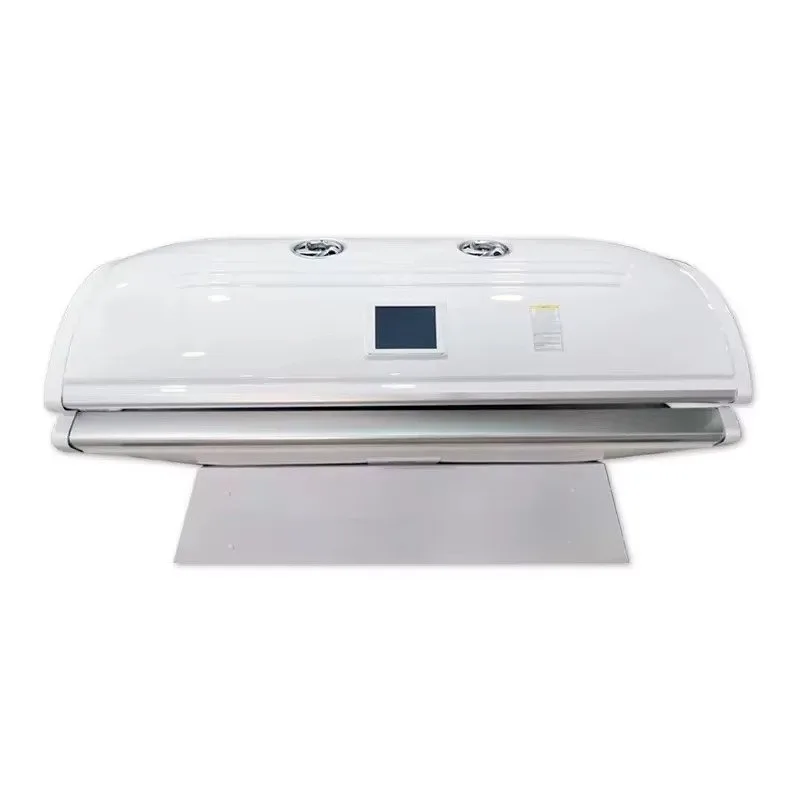
A full‑body red light therapy bed is a standing or reclined enclosure of high‑density LEDs that delivers red and near‑infrared light across the whole body. Clinics and commercial wellness operators use beds for skin and aesthetic services, recovery/anti‑inflammation sessions, and general wellness add‑ons to existing packages. These systems are a commercial appliance: buyers should treat them like an electrical, optical and service asset rather than a single‑purpose consumable.
Key technical specs to request and compare — what they mean for effectiveness and safety

Below are the specific technical items that separate useful quotes from marketing noise, and why each matters when you evaluate a supplier:
- Irradiance (mW/cm²) and measurement method: This is the instantaneous light power at the surface. Ask for point measurements and a uniformity contour across the bed at the intended treatment distance. Without the sensor type and distance the number is not comparable.
- Wavelength(s) (nm): Red (≈630–660 nm) and near‑infrared (≈800–850 nm) are the common bands. Confirm the delivered centre wavelengths and claimed accuracy and whether the bed offers other bands as custom options.
- Per‑wavelength control and pulse/frequency: Beds that allow independent power/pulse control per wavelength are more flexible for commercial treatment menus. Verify supported frequency ranges and dimming resolution.
- Power and supply: Confirm nominal power rating, actual measured power draw under full load, and required input voltage/current. For installation planning, include inrush and continuous current values.
- Cooling and duty cycle: Continuous high irradiance generates heat. Ask about active cooling, recommended maximum continuous session lengths, and cooling‑related failure modes.
- LED lifetime and maintenance: Request the LED lifetime metric and the conditions under which it was measured (driving current, temperature).
- Safety features: Interlocks, emergency stop, eye‑safety guidance and shielding should be documented in the technical manual.
MAIKONG MK-0001 example: supplier‑provided specification snapshot
Below are MAIKONG’s published values for model MK-0001 so you can see how supplier data is presented and which numbers you should verify in detail.
| Field | Value |
|---|---|
| Model | MK-0001 |
| Wavelengths | 850 nm, 660 Nm (customize: 450nm, 589nm, 635nm, 660nm, 810nm, 850nm, 940nm, etc) |
| Irradiance | 80 mW/cm² – 160 mW/cm² |
| Power / Actual power | Power: 3500 W; Actual power: 3.5–4.5 kW |
| Input voltage | 220v 30A (plug type: US) |
| Frequency (pulse) | 1–5000 Hz |
| LED lifetime | 10,000 hrs |
| Dimensions | 190 / 240 cm |
These values are MAIKONG’s published specifications; we use them as a concrete example but do not substitute for a supplier test report or an on‑site power measurement. For traceability, ask the supplier to attach test logs or video of the irradiance and electrical tests for the serial batch you will purchase.
Why irradiance and wavelength distribution matter for full‑body systems
Irradiance determines how much light energy reaches tissues per unit area and therefore influences session duration and delivered dose. For full‑body beds you should focus on both peak irradiance (for high‑dose applications) and uniformity (so a full session doesn’t underdose or overdose portions of the body). Wavelength specifies the optical band delivered; different applications typically rely on red and near‑infrared bands. Confirm whether the supplier measures each band separately and provides per‑band irradiance figures.
Control features and treatment flexibility: pulse, frequency and per‑wavelength control (what to ask suppliers)
- Can each wavelength group be switched independently? (on/off, 0–100% power)
- What are the pulse frequency and pulse width ranges and resolution?
- Is there programmable sequencing (multiple presets) and is it user‑configurable by the clinic?
- Does the control interface provide logs of usage, run hours and error codes for service diagnostics?
Electrical, installation and room requirements U.S. distributors must check
Do not assume U.S. readiness from a plug label alone. For MK‑0001 MAIKONG publishes Input Voltage: 220v 30A and Plug type: US (data‑fact-id=”127″). That combination means you must verify the buyer’s site wiring, available breakers, and if the bed will operate correctly on local phases and voltages. Ask suppliers for:
- Measured full‑load current, inrush current, and recommended breaker/fuse sizing;
- Whether the unit is single‑ or three‑phase and the connector type;
- Exact packed dimensions (MAIKONG single package size: 210 x 147 x 165 cm) and gross weight (68.000 kg) so you can quote freight and door clearance;
- Installation requirements and whether on‑site electrician work is recommended.
Durability, service and maintenance: LED lifetime, cooling, spare parts and warranty items to confirm
Key vendor commitments to confirm in writing:
- LED lifetime and how it was measured (MAIKONG lists LED lifetime: 10000 hrs — data‑fact-id=”127″);
- Cooling design and number/location of fans, recommended maintenance interval (MAIKONG notes multiple fans for cooling in its description);
- Spare parts policy (MAIKONG states “Free Spare Parts” as a service item — data‑fact-id=”127″);
- Warranty coverage detail (MAIKONG warranty: 1 Year — data‑fact-id=”127″) and what costs the buyer will bear for shipping and labor after the warranty period.
Regulatory and supplier due diligence for distributors — documents and declarations to request
Document checklist to obtain before placing an order:
- Supplier declaration of conformity and copies of their declared certifications (MAIKONG declares ISO 9001, CE and ISO 13485 at company level). Ask for certificate scans and scope pages.
- Safety test reports for electrical compliance (e.g., IEC/EN or U.S. equivalents). If none are supplied, clarify required local testing and who pays.
- Irradiance and wavelength test reports with measurement method, sensor model and calibration date.
- Service and spare parts lead times and the supplier’s contact for technical support.
Commercial fit: applications and ROI signals distributors should discuss with buyers
Talk to buyers about their business model: session pricing, expected throughput, and whether the device will be a stand‑alone revenue generator or an add‑on. Full‑body beds generally require more floor space and higher power than panel arrays; they offer client convenience and perceived value but need higher capital and electrical capacity. Ask clients for projected session volume and space constraints so you can recommend bed vs. large panel solutions.
What to include in a quote request or specification sheet to suppliers (concise checklist)
- Model name and serial (e.g., MK‑0001) and requested custom wavelengths, if any.
- Request irradiance maps at treatment distance and per‑wavelength mW/cm² figures.
- Electrical data: nominal voltage, phase, full‑load current, inrush current, plug type and recommended breaker size.
- Mechanical data: installed footprint, packed dimensions and gross weight (MAIKONG: 210X147X165 cm; 68.000 kg — data‑fact-id=”127″).
- Control features: per‑wavelength control, pulse frequency range (MAIKONG: 1–5000 Hz — data‑fact-id=”127″), programmable presets, logging.
- Service: warranty terms, spare parts list and lead times, maintenance schedule.
- Required documentation: test reports for irradiance, wavelength, electrical safety, and copies of relevant certifications.
Short comparison prompts distributors can use when evaluating beds vs. large panels
Use these prompts to frame supplier replies and make apples‑to‑apples comparisons:
- Energy per session: provide irradiance × area × session time; compare to panel solutions at the same distance.
- Uniformity map: supply a 2‑D irradiance contour versus distance for the entire treatment area.
- Site impact: state required breaker size, typical room footprint and ventilation needs.
- Operational model: outline estimated session throughput and maintenance intervals for each option.
Evidence: supplier‑reported MAIKONG specifications used in this article
The values shown above for MK‑0001 are taken from MAIKONG’s published product information (model MK‑0001). Key supplier‑reported facts used here include wavelengths (850 nm, 660 Nm), irradiance range (80–160 mW/cm²), actual power (3.5–4.5 kW), input voltage (220v 30A), frequency (1–5000 Hz), LED lifetime (10,000 hrs), dimensions and packaging details, LED counts and warranty. These are company‑published specifications (data‑fact-id=”127″).
Risks and limitations you must consider
Supplier specifications are self‑reported: verify test reports before acceptance. The listed Input Voltage for MK‑0001 is 220v 30A (data‑fact-id=”127″); do not assume compatibility with all U.S. sites. We did not find third‑party electrical safety reports or UL/ETL listings in the provided product snapshot—request those explicitly. LED lifetime and irradiance are subject to operational conditions (drive current, temperature); confirm how the supplier measured these values. Finally, none of the technical parameters in this article should be interpreted as a medical claim—treatment protocols and efficacy must be determined by qualified clinicians.
Quick checklist for sending to suppliers (copy/paste)
- Model: MK‑0001 — confirm serial or variant.
- Provide irradiance maps at treatment distance for each wavelength band; include sensor model and calibration date.
- Provide per‑wavelength centre nm values and manufacture tolerance.
- Provide measured full load and inrush current, recommended breaker/fuse, and whether unit is single/three‑phase.
- Attach electrical safety test reports and copies of declared certifications.
- State spare parts list, lead times and warranty scope in writing.
For more model details and factory background, see our MAIKONG Red light therapy bed page: MAIKONG Red light therapy bed.
Next step — request configuration details or a quote
If you want a technical quotation or batch test data for MK‑0001, email our U.S. contact with the checklist above and your intended installation details (site voltage, room dimensions, expected session volume): lucy@maikongbed.us or call/WhatsApp +8613510907401. We will supply configuration options, lead time (15–21 days as published), MOQ and packaging details.
Disclaimer: Content is for product selection and health‑management information only and does not replace professional medical diagnosis or clinical protocols.
This content is provided for learning, information sharing and professional communication only. It is not medical advice and is not a basis for treatment or diagnosis. Confirm suitability, operation and purchasing requirements against the product manual, local regulations and qualified professional guidance.
Contact us byWhatsApp Online:

Maybe you like also
Copy©2025