Categories
- No categories
FAQ About Red Light Therapy – Spectra Red Light: For U.S. red‑light therapy startups, a full‑body red light therapy bed is a commercial LED photobiomodulation device that delivers specific red and near‑infrared bands. It suits clinics, recovery studios and spas; verify wavelength, irradiance, control modes, electrical requirements and factory test reports before procurement to confirm safety and dose.
We wrote this for U.S. red light therapy startups that must decide whether to buy or offer full‑body beds. Your priorities are factual: what the machine is, who it serves, where it fits commercially, what the safety and operational limits are, and exactly which parameters or documents you can use to verify vendor claims. We speak as MAIKONG, the manufacturer, and point to supplier‑reported values you should validate in procurement.
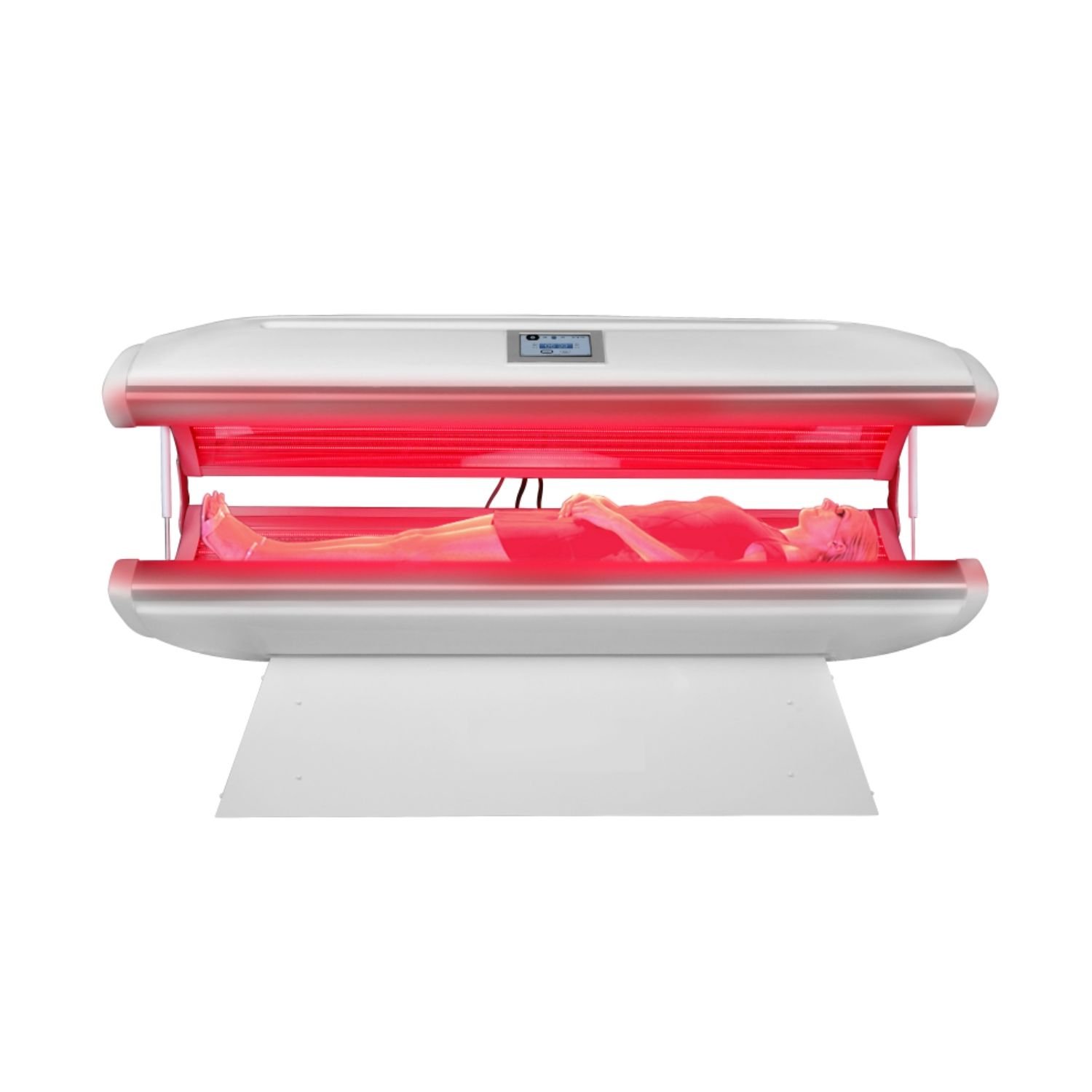
A red light therapy bed is a commercial LED array cabinet designed for whole‑body photobiomodulation (PBM). It emits red and near‑infrared wavelengths at controlled irradiance and timing to deliver a programmed optical dose to the skin and superficial tissues. MAIKONG lists this product as the Full Body Red Infrared Light Bed, model MK-0001, with customizable spectra and support for pulsed/dimmable output. Source
The following buyer checklist table shows which measurable parameters and supplier statements are most relevant and quotes MAIKONG’s reported values so you know which items to verify during due diligence.
| Parameter to verify | MAIKONG reported value (supplier‑reported) | Why this matters |
|---|---|---|
| Wavelength(s) | 660 nm and 850 nm (customizable; other bands available) | Wavelength controls tissue penetration and which chromophores absorb energy; confirm with spectral graphs and LED supplier specs. |
| Irradiance / Power density | 80–160 mW/cm² (reported) | Irradiance determines dose and session duration; verify with independent irradiance maps at working distance. |
| Control features | Pulse/dimmable support; frequency 1–5000 Hz | Pulsing and channel control change effective dose and thermal load; verify via demo and control‑interface logs. |
| Electrical requirements & power | Actual power 3.5–4.5 kW; input voltage stated 220V 30A | Impacts installation costs (service panels, breakers) and running costs; confirm measured power consumption. |
| LED quantity & lifetime | 3500 pcs (big) / 26400 pcs (small); LED lifetime 10,000 hrs | Composite of coverage, redundancy and expected service life; request BOM and LED datasheets. |
| Warranty & after‑sales | Warranty: 1 Years; free spare parts reported | Commercial uptime depends on warranty scope, spare parts and local service support. |
All quoted product values above are MAIKONG supplier statements and should be validated with lab reports, on‑site tests or video evidence. Source
Procurement for a commercial red light bed is about measurable, repeatable evidence. Ask for and confirm the following items as part of any RFQ or factory visit:
Decisions typically trade session time against safety and cost. Higher irradiance (reported 80–160 mW/cm² for MAIKONG) reduces session duration, which increases throughput but raises thermal stress and ocular exposure risk. Pulsing (1–5000 Hz reported) can reduce average thermal load and offer protocol flexibility but requires more complex verification and firmware transparency. Source
Operationally, choose a bed configuration that matches your service model: high‑irradiance setups for short, premium sessions; lower irradiance for longer, lower‑cost memberships. Whatever you choose, require measured evidence for the specific configuration you will operate.
MAIKONG’s verified product record for the MK-0001 red light bed lists wavelengths, LED counts, irradiance, power, frequency range, dimensions and warranty details—these are supplier‑reported facts. Use the product page as a starting document and request corroborating test reports for every critical procurement variable. Source
MAIKONG’s enterprise profile states factory-level capabilities: 21 years in LLLT manufacturing, vertical integration including PCB assembly and molding, and certifications such as ISO 13485 and CE. Treat these as manufacturing‑practice indicators but still verify device‑level test data. Source
Suitability scenario: a U.S. biohacking studio adding a single full‑body bed to its recovery suite. With adjustable spectra and pulse control, you can create short high‑dose sessions and longer low‑dose sessions for different client tiers. MAIKONG positions the MK-0001 for commercial settings including beauty spas, clinics and fitness centers; confirm the configuration and electrical needs before installation. Source
Operational checklist for the scenario: plan electrical upgrades for 220V/30A or equivalent, confirm room ventilation for heat, schedule staff training on contraindications and eye safety, and measure irradiance in situ after installation. MAIKONG reports actual power 3.5–4.5 kW—verify compatibility with your local supply. Source
Red light beds are non‑invasive but bring concrete risks if misused: insufficient eye protection, uneven dose across the treatment surface, overheating from inadequate cooling, mismatched electrical supply, and supplier claims without evidence. Mitigate these by requiring independent irradiance and spectral reports, thermal run‑time tests, clear eye‑safety procedures, and a written spare‑parts and warranty agreement. Avoid suppliers who refuse demonstrations or raw test files.
Regulatory and medical boundary: these devices are for wellness and photobiomodulation; they are not a replacement for medical diagnosis or a guaranteed treatment. Any therapeutic claims must be supported by clinical literature and compliant labeling; do not accept absolute medical promises from a vendor. MAIKONG provides safety and maintenance statements on its product page—get these in writing. Source
When a device is operated within verified irradiance/time parameters and users wear appropriate eye protection, red and near‑infrared LED therapy is generally low risk. Safety depends on device quality, cooling, power‑stability and trained operators. Confirm safety testing, cooling design and documented operating procedures before offering sessions.
Verify spectral graphs (wavelength peaks and bandwidth), irradiance maps (mW/cm² across the treatment surface), control functionality (pulse and dimming), measured power consumption, LED lifetime claims, cooling design and warranty terms. MAIKONG’s product page lists many of these items for MK-0001—request raw test reports and on‑site measurements. Source
Require citations to peer‑reviewed clinical studies for the specific use case and ensure the device’s spectral and irradiance parameters match those used in the studies. Vendor marketing assertions are insufficient; map the study parameters to the device’s measured output and ask for reproducible treatment protocols. MAIKONG states that treatment plans are based on clinical evidence—obtain references and matching device settings. Source
Primary supplier data in this guide comes from MAIKONG’s verified product record for the Full Body Red Infrared Light Bed (MK-0001). For the product page and supplier documentation, see MAIKONG’s listing: MAIKONG — Red Light Tanning Beds. Source
Author / reviewer: MAIKONG Industry Co.,Ltd (product and manufacturing team editorial). Last updated: 2026‑08‑30 (company record).
If you are a U.S. red light therapy startup that wants MAIKONG’s MK-0001 documentation, demonstration videos, or a formal quote, contact us. We provide OEM options, customization and distributor terms. Visit our product page or request detailed test files and on‑site verification prior to purchase.
Contact CTA: Request information or a quotation at https://maikongbed.us/red-light-tanning-beds/ or email lucy@maikongbed.us. Phone/WhatsApp: +8613510907401.
This content is provided for learning, information sharing and professional communication only. It is not medical advice and is not a basis for treatment or diagnosis. Confirm suitability, operation and purchasing requirements against the product manual, local regulations and qualified professional guidance.